

Volunteer
Become a CASA
As a Court Appointed Special Advocate (CASA), you would establish and maintain contact with a child, interview his or her parents, social workers, teachers, and others, and submit a written recommendation to the court outlining what is best for the child. You would become the “eyes and ears” for the judge and help ensure that “your” child does not become lost in the court system. If you care and have about 10 hours a month to spend, being a CASA can be very gratifying work.
Become a Volunteer
There are numerous ways to help CASA. We have a continual need for office help, people who can volunteer a half day each week on a regular basis. In addition, we need people to help coordinate fund raising and other activities.
Become a Friend of CASA
Friends of CASA sponsors annual fund raisers including Hearts for Children and others… Corporate/business sponsorships through event underwriting are greatly needed. You could also assist by attending the events, serving on a committee, or donating merchandise or services to be used as auction items.

Steps to Become a CASA
A Court Appointed Special Advocate (CASA) is a trained volunteer appointed by a judicial

What is a Court Appointed Special Advocate (CASA)?
There are numerous ways to help CASA. Office help, fundraising, special events, etc.

CASA Training
Quarterly training to prepare our foster child advocates for their advocacy role.

Other Volunteer Opportunities
CASA has an established Internship program for students. If you are interested in participating

CASA Volunteer FAQ
Court Appointed Special Advocates (CASA) volunteers are much more than mentors.

En Español
CASA – Defensores Especiales Nombrados por la Corte (Court Appointed Special Advocate en inglés)
Steps to Become a Volunteer
A Court Appointed Special Advocate (CASA) is a trained volunteer appointed by a judicial officer to provide advocacy for a child who is under the jurisdiction of the courts due to abuse or neglect. The CASA serves as the “eyes and ears” of the judge for children in foster care. Volunteers spend time with children, monitor needed services, and provide child-focused recommendations to the court based on the best interest of the children they serve. As a Court Appointed Special Advocate (CASA), you would establish and maintain contact with a child, interview social workers, teachers, and others professionals involved and submit a written recommendation to the court outlining what is best for the child. If you care and have about 10 hours a month to spend, being a CASA can be very gratifying work.
Court Appointed Special Advocates (CASA) volunteers are ordinary people doing extraordinary work for abused, neglected and abandoned children and youth in foster care in our community.
As sworn officers of the court, CASA volunteers are appointed by a juvenile court judge to advocate one-on-one for children and youth in foster care. As an advocate you will be a powerful voice for a child or youth during their uncertain journey in the foster care system.
You don’t have to be a lawyer or social worker. CASA of Sonoma County will provide you with the training you need to succeed.
CASA volunteers come from various walks of life. They share the willingness and ability to commit two years, and 10 hours a month, to a foster child or youth to make a difference.
Ready!
Set!
Step 2: Excited to be a CASA volunteer?
To be scheduled for an interview, you will need:
Copy of your driver license
Copy of your automobile proof-of-insurance card
Application
Court Appointed Special Advocate (CASA) Application:
Thank you for your interest in becoming a CASA volunteer and taking time to complete our application. This application takes approximately 30 minutes to complete and must be submitted before your pre-training interview.
PLEASE NOTE: THIS APPLICATION CAN ONLY BE SUBMITTED ELECTRONICALLY. The application cannot be saved so you need to complete it in one sitting. You do have the ability to print a copy of the application so you can review the questions and gather information before getting started.
You will be asked for 3 references. One reference from a recent employer (or volunteer role), one from someone who has seen you interact with children, and one personal reference. Please provide complete and current emails.
All information provided is held in the strictest confidence and is encrypted and safeguarded against electronic tampering by Optima.
Be sure to press the “SUBMIT” button at the end.
You can open the application by clicking here
Questions?
Contact our Training Coordinator
707-565-6375 or tccasa@sonomacasa.org
Step 3: Congratulations! You’ve completed the interview process and all required security screening and have been accepted into Volunteer Initial Training. The next step is to complete Volunteer Initial Training, which consists of 40 hours of classroom training, and post-training site visits to other organizations assisting our youth.
CASA of Sonoma County conducts quarterly training sessions each year which are held in the fall, winter and spring and summer. Classes are taught by CASA staff, volunteers, and experienced professionals from the various disciplines and agencies who work with foster children during the dependency process.
Go!
What is a Court Appointed Special Advocate (CASA)?
There are numerous ways to help CASA. Office help, fundraising, special events, etc.
If you’re ready to give children hope in Sonoma County, contact us today!
CASA OF SONOMA COUNTY VOLUNTEER JOB DESCRIPTION
Position Title: Court Appointed Special Advocate (CASA)
Reports to: CASA Volunteer Supervisor (Case Supervisor)
Responsible to: CASA of Sonoma County Executive Director and Sonoma County Juvenile Court Judge
General Requirements: Volunteers must be at least 21 years of age. Each CASA must demonstrate the desire and willingness and ability to help and mentor a child, make at least two years commitment, attend CASA training sessions, successfully complete a CASA background screening, receive CASA program staff supervision, work effectively alongside other foster care system professionals, and report to the Court.
Roles and Responsibilities (according to California Rule of Court 5.655)
- Establish a relationship with a child in foster care to better understand the child’s needs and desires:
- Develop a relationship with the court dependent child by meeting with him/her on a weekly basis.
- Provide a positive role model for the child while teaching him/her self-confidence, trust, and other developmental behaviors.
- Support the child throughout court proceedings:
- Learn about the foster care and dependency court systems;
- Explain the court proceedings to the child;
- Attend each hearing with or without the child;
- Help “interpret” what is going on in court while at court with the child, or following court.
- Explain the CASA volunteer’s role, duties and responsibilities to all parties associated with the case.
- Review available records regarding the child’s family history, school behavior, medical or mental health history, etc.
- Identify and explore potential resources that will facilitate family preservation, early family reunification, or alternative permanency planning.
- Interview all parties involved with the child regarding the child’s circumstances and needs, as determined by the CASA plan developed with the CASA Advocate Supervisor.
- Communicate the child’s needs to the court in written reports and recommendation.
- Ensure that the court-approved plans for the child are being implemented.
- Familiarize yourself with the case plan.
- Maintain regular contact with the social worker.
- Investigate the interest of the child in judicial or administrative proceedings outside of juvenile court.
- Communicate and coordinate efforts with the child’s social worker, probation officer, and attorney.
- Other duties and responsibilities as determined by the presiding juvenile court judge or a designee.
Additional Requirements:
- Attend 30 hours of CASA class training and 10 hours of field visits and observations.
- Submit monthly volunteer activity logs to the CASA office.
- Submit draft of court report at least one month before court hearing date.
- Maintain regular contact with your CASA Advocate Supervisor.
- Attend a mandatory 60-day case review meeting.
- Acquire 12 hours per year of in-service training.
- Stay with the child until the case has been closed by the court or CASA has been dismissed.
- Notify the office immediately if no longer able to serve as a CASA volunteer.
- Maintain confidentiality regarding the CASA child and his/her case.
Advocates are prohibited from:
- Talking about a CASA child, their family, or any court proceedings with persons not involved with the case, such as family members, friends, co-workers, etc;
- Taking a child to the CASA volunteer’s home;
- Introducing their CASA child to their families and other persons in their personal life;
- Working with a child with who they are either related or have a prior relationship with;
- Giving legal advice or therapeutic counseling;
- Giving money or expensive gifts to the child or family;
- Making any placement arrangements on the child’s behalf;
- Being employed in a position and /or with another agency/organization that might result in a conflict of interest; and
- Any other activities prohibited by the local juvenile court and foster care system.
CASA Training
The CASA of Sonoma County Program offers quarterly training to prepare our foster child advocates for their advocacy role.
Please call 707-565-6375 or email us if you would like to sign up or would like more information about attending the CASA training.
REGISTRATION IS REQUIRED!
Winter 2025:
January 13th – 24th
Spring 2025:
April 14th – 25th
Summer 2025:
July 14th – 24th
Fall 2025:
October 14th – 23rd
Other Ways to Get Involved
Internships
CASA has an established Internship program for students. If you are interested in participating, please contact our Executive Director, Heloisa Heinen, at 707-565-6375.
Volunteer Office Advocates
CASA is always in need in volunteer Office Advocates, an integral part of our daily operations. Office Advocates help run the front office, prepare for important meetings and training sessions, and coordinate events, etc. If you want to volunteer for CASA, but do not have enough time to take on a child’s case, this is another great way to help out. If you ‘re interested, please contact our Executive Director, Heloisa Heinen, at 707-565-6375.
Event Volunteers
CASA is always in need in volunteer event workers. If you would like to be a part of our annual fundraisers (Hearts for Children, etc…), or help staff our event booths throughout the year, please contact our Executive Director, Heloisa Heinen, at 707-565-6375.
Board of Directors (Volunteer)
If you are interested in sitting on the Board for CASA of Sonoma County, please contact our Executive Director, Heloisa Heinen, at 707-565-6375.

CASA Volunteer FAQ
En Español
¿QUÉ ES CASA?
CASA – Defensores Especiales Nombrados por la Corte (Court Appointed Special Advocate en inglés) del Condado de Sonoma es una organización no lucrativa que trabaja en conjunto con la Corte de Dependencia Juvenil del Condado de Sonoma y la oficina de Servicios a Familias y Niños para proveer Defensores Voluntarios para aquellos niños y jóvenes referidos por la Corte.
¿QUÉ ES UN VOLUNTARIO DE CASA?
Los voluntarios de CASA son miembros de la comunidad que han sido cuidadosamente seleccionados y capacitados para trabajar directamente con niños y jóvenes cuyas familias están involucradas con la Corte de Dependencia Juvenil. Ellos son funcionarios de la Corte y trabajan en estrecha colaboración con un supervisor empleado por CASA, quien le provee apoyo y dirección.
CASAs sirven como la voz del niño dentro del sistema de dependencia y cuidan de los intereses de los niños y se aseguran de que los intereses de los niños sean atendidos de la mejor manera. Ellos trabajan uno a uno con los niños de cuidado de crianza, proveyendo apoyo emocional y educacional crítico, asegurándose que las necesidades de cada niño sean cumplidas y al mismo tiempo su voz sea escuchada, mientras estos navegan por el sistema.
Voluntarios generalmente visitan al niño/joven una vez por semana. Las visitas pueden incluir salidas a paseos dentro de la comunidad. Para jóvenes de 18-21 años, voluntarios funcionan como mentores y ayudan con la transición a la independencia.
Voluntarios están en comunicación con abogados y trabajadores sociales, y además de visitas regulares con el niño/joven a quien están asignados, ellos también se hacen responsables de revisar registros de información relacionados con el caso y de entablar comunicación con cualquier persona presentemente involucrada en la vida del niño/joven. Esto incluiría a los padres, miembros de la familia, terapeutas, y maestros. Los Voluntarios se dedican a familiarizarse con los intereses y necesidades del niño/joven, al igual que los puntos fuertes de él o ella y de su familia. Con toda la información reunida, el Voluntario escribe informes o reportes a la Corte y hace recomendaciones al Juez referente a la seguridad y el bienestar del niño/joven.
Nota: Muchos de nuestros voluntarios son bilingües pero nuestras sesiones de información SON SOLO en inglés y todas las comunicaciones serán en inglés. Únase a nosotros para hacer la diferencia un niño a la vez.
Como voluntarios de CASA, tendrás la oportunidad de:
- Completar un programa de formación integral
- Jurar enfrente de un juez como un defensor especial designado por la corte (CASA).
- Escoger un niño de CASA. Nuestro personal te ayudara a revisar varios casos para escoger a un niño y emparejarte con él.
- Tendrás acceso a cada aspecto del caso de su niño de CASA, incluyendo juntas con los maestros, trabajadores sociales, abogados y familia de crianza.
- Proveer reportes a las cortes relacionadas con las necesidades y mejores intereses del niño.
Un voluntario de CASA puede significar una gran influencia en la vida de un niño de cuidado de crianza dentro y fuera del edificio de la corte. Al ser voluntario trabajando uno-a-uno con el niño usted le muestra compasión durante su jornada hacia un hogar seguro, lleno de amor y permanente. Los estudios demuestran que la presencia de un adulto de apoyo estable en la vida de un niño puede afectar profundamente el futuro de ese niño.
Al mismo tiempo, usted tiene la oportunidad de enriquecer su propia vida. En una encuesta reciente, el 99% de nuestros voluntarios informaron de que su experiencia como voluntario fue satisfactorio, y en muchos casos fue una experiencia que cambio sus vidas.
¿POR QUÉ SER VOLUNTARIO DE CASA?
Los hechos del cuidado de crianza y defensores de niños del Condado de Sonoma:
- 45% de los niños en el sistema de bienestar de menores en el condado de Sonoma son latino o Latina.
- Los defensores de niños del condado de Sonoma proporcionan estabilidad y esperanza a los niños que han sufrido abuso y negligencia de menores.
- Hay más de 550 niños en el sistema de cuidado de crianza ahora del condado.
- Los Voluntarios de CASA son adultos amables y estables durante lo que puede ser un tiempo con muchos cambios y transiciones.
LA NECESIDAD
Hay más de 550 niños en el sistema de cuidado de crianza ahora del condado. Los niños de cuidado de crianza se encuentran entre los miembros más vulnerables de nuestra comunidad. Enfrentando la incertidumbre y la decepción que viene al ser desarraigados de su CASA, la escuela, su familia y amigos, estos se convierten en parte del sistema de bienestar de menores sobrecargado y a menudo dividido por las grietas de este sistema.
Estos niños necesitan un adulto en el cual ellos puedan confiar – una voz poderosa para guiarlos y abogar por ellos. ¿Está listo para defender a un niño de cuidado de crianza en su comunidad?
REQUERIMIENTOS PARA SER UN DEFENSOR ESPECIAL DESIGNADO POR LA CORTE
- Tener al menos 21 años de edad
- Entender y leer ingles
- Comprometerse a pasar de 2-4 horas por semana con su niño asignado, por un periodo de aproximadamente dos años
- Actualmente no usar drogas ilegales
- No tener condena de DWI o DUI dentro de los últimos siete años
- No tener condenas por delitos graves (felony)
- No estar en libertad condicional
- No tener problemas graves de salud física o mental que podrían afectar su capacidad para ser voluntario
- No tener previas condenas o cargos pendientes que lo impliquen en un delito sexual o el abuso o negligencia de un menor de edad. Si esto es el caso, bajo ninguna circunstancia se le podría aceptar como voluntario.
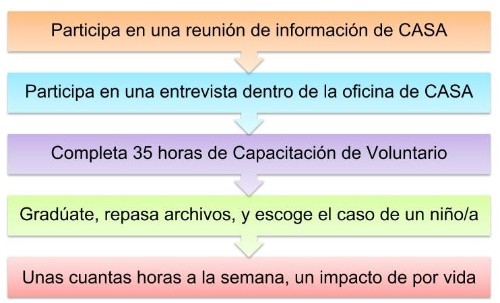
Tome el primer paso. Asista a una sesión informativa lunes y miércoles 10:00 am, 11:00 am o 12 para obtener más información en inglés.
Comuníquese con Defensores de los niños – CASA del Condado de Sonoma al 707-565-6375 o envíenos un correo electrónico a tccasa@sonomacasa.org. Nuestra Coordinadora hablas español.